
Fully Automated Powder Enameling Starting at a Batch Size of 1
The home appliance manufacturer V-ZUG operates the world’s most advanced powder enameling facility in Switzerland
V-ZUG is the leading Swiss brand for home appliances. For over 100 years, V-ZUG AG has been developing and manufacturing kitchen and laundry appliances at its main production site in Zug, Switzerland, and—since 2013—refrigeration appliances in Arbon and, more recently, in Sulgen, Switzerland.
Everything is produced in-house in Zug—from sheet metal to the finished product. In line with the company’s premium standards, its ovens, steamers, dishwashers, washing machines, and clothes dryers are positioned in the high-end price segment. Quality and functionality are top priorities for all products. To further enhance this standard, the company invested in a new powder-enameling plant. “We chose ASIS because, in the run-up to the project, they convincingly demonstrated that they could design and build such a plant,” said Roland Häfliger, Project Manager for Parts Manufacturing & Surface Technology at V-ZUG. “ASIS was also one of the few suppliers to offer to act as the general contractor for the entire plant.”
Growth
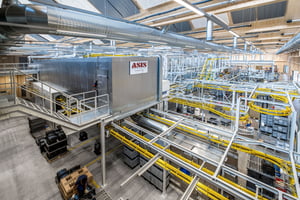
The “V” in the company name V-ZUG dates back to its founding as a galvanizing plant; since then, the town on picturesque Lake Zug has developed around the company. Due to limited available space, production can now only expand vertically. The plan is to produce twice as much in the future using nearly half the floor space. All components of the approximately 1,400 m² coating center were designed so that they could be installed on the second floor of a modern timber-frame building. Wood, a renewable raw material, is not only sustainable; it also creates a pleasant atmosphere in the so-called Zephyr Hangar, which is an unusually pleasant surprise compared to other industrial production facilities. Between 40 and 50 different components can be automatically coated, starting from a batch size of 1. The product range includes four basic types of baking pans and various flat products, such as convection baking sheets and baking trays.
Automatic Feeding
The baking pans emerge from the welding line every 50 seconds and are automatically transferred to a flat conveyor belt. Their first stop is the bracket and clip application station. There, clips are automatically attached. These cover specific areas to protect them from the enamel powder, ensuring they remain uncoated for further processing. Next, retaining brackets are automatically attached, and the baking pans are transferred to the Power & Free conveyor system by a transfer robot. Flat items are loaded at a separate manual station.
Pre-treatment
At the 5-zone spray pretreatment station, all parts are cleaned of burrs and dirt to ensure optimal coating quality. The spray pumps of the dual-line system are controlled not by throttle valves, as is customary, but by frequency converters. This enables seamless integration into the PLC system control, and the most efficient operating conditions—such as pause cycles—can be set. The spray pressure is maintained at a constant level via electronic pressure line monitoring. Special attention was paid to minimizing flushing agent consumption through the use of a cascade system. After the blow-off zone, the workpieces are dried in the overhead condensate dryer, ensuring that no water residue remains on the surface.
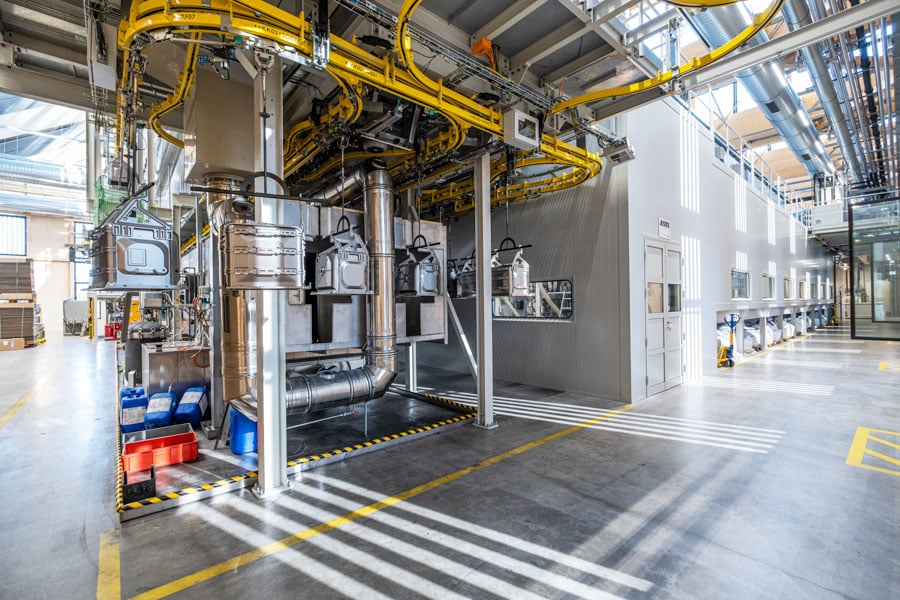
The 5-zone spray pretreatment system removes all contaminants from the mechanical manufacturing process.
Application Combination
All powder coating operations take place in a climate-controlled enclosure. The baking pans and flatware are coated in a total of three powder coating booths. ASIS’s experience in the household appliance industry has shown that the combination of robots and linear axes represents an ideal setup. The cost-effective linear axes coat the vertical, flat surfaces, while the robots apply powder to edges and interior areas. Two booths handle the base powder coating, and the third powder booth is dedicated to the specialized coating of steam cookers. Sensors detect which part is entering the system, and the parameters and programs are optimally adjusted accordingly.
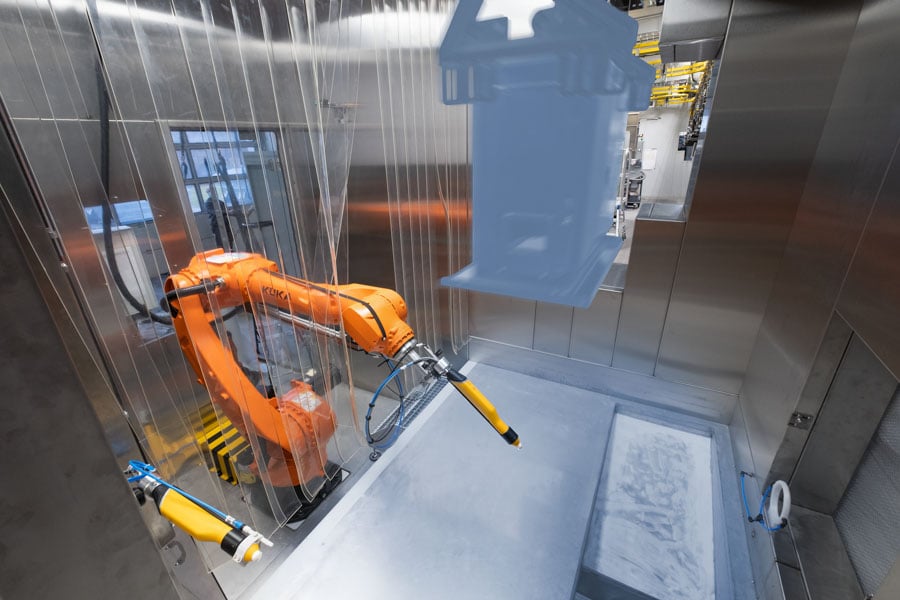
Powder application takes place on three powder coating lines inside the climate-controlled enclosure.
Challenge Accepted
“V-ZUG’s requirements were very high from the start; great emphasis was placed on automation and digitalization,” recalls Dietmar Binder, Project Manager and Sales Representative at ASIS. “One challenge was that we wanted to move through the system using just one conveyor system—the Power & Free conveyor—and only a single standardized trolley train and hangers.” This makes sense, of course, as it simplifies the overall process and eliminates the need for additional sorting functions within the system. This was implemented using a transfer robot and a hanger cleaning system designed by ASIS. The transfer robot removes all workpieces from the hangers, which were also coated with powder during the application process. These are cleaned in the hanger cleaning system in the meantime, allowing the robot to transfer the workpieces to the same, cleaned hangers, which are then transported to the enamel firing furnace.
The enamel powder is fired at a temperature of 850 °C. The custom-built corrugated sheet conveyor safely transports the Power & Free conveyor’s trolleys—with the hanging trolleys attached—through the furnace and then returns them. The flexible flaps seal off the top of the furnace at all times, ensuring that no energy is lost, while also protecting the overhead trolleys and the conveyor chain, which are not designed to withstand these temperatures. The outgoing baking chambers, which are still hot, transfer their heat to the incoming workpieces. The furnace has nine firing zones with different temperatures, heated by 16 burners. Currently, the annealing furnace is still powered by natural gas; a transition to hydrogen is in the works. Gleaming black, like Swiss dark chocolate, the workpieces leave the furnace and line up in the cooling buffer to continue cooling.
One might almost think they are now ready for assembly. Depending on customer specifications, some parts undergo further finishing. In another chamber, a robot applies a durable non-stick coating, which is then dried in a convection dryer at 250 °C.
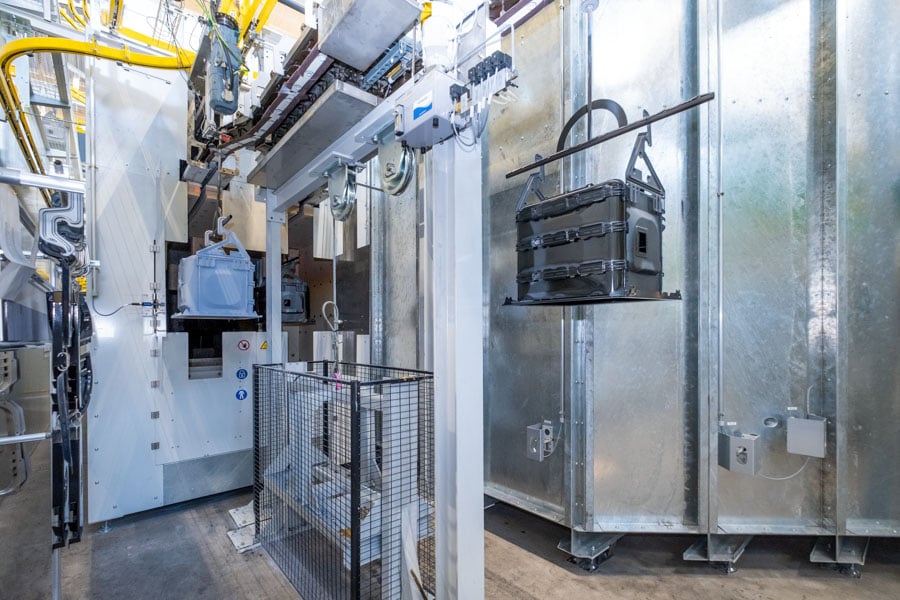
In the curing oven, the workpieces are transferred to a corrugated sheet conveyor.
Digitalization and Sustainability
“We chose ASIS because we place great value on functionality and quality, which includes seamless traceability of quality data throughout the processes,” says Roland Häfliger. This is made possible by the Surface-Analytics 4.0 software. All process data from the system is recorded in a central database. Users can access it via smartphone, tablet, or laptop. In addition to key metrics and reports for optimizing system performance, every individual part can be fully traced.
A small number of components that do not initially meet the high quality requirements are subsequently brought up to top standard in the rework booth. Naturally, everything is recorded transparently and traceably via a touch panel. Reworking instead of discarding—that, too, is sustainability in the production process.
Precise Preliminary Planning
The entire system was digitally modeled in advance. In addition to standard feasibility studies, the robots were simulated and their programs were created offline. The robot simulations for all individual stations and the entire material flow within the system were integrated into a comprehensive simulation. The varying process times of the stations were taken into account. This allowed for precise predictions regarding the design of the conveyor system with buffer sections, sources of error in individual areas, zones operating in parallel, and the expected throughput.
“It’s hard to pinpoint the highlight of the facility—it’s really the facility as a whole,” summarizes Roland Häfliger. “The entire plant is unique in its functionality.” Each individual process was precisely coordinated—like a Swiss watch—automated, and linked via a unified control system.
German engineering meets Swiss precision—through customer-oriented preliminary planning, robotics expertise, and the use of digital solutions, the world’s most advanced enameling plant was created in Switzerland.