From Manual Painting to Robots
Retrofit Instead of a New System: How Contract Coater Diebald Successfully Made the Transition to Robotics
Rising quality requirements, recurring production runs, and the growing shortage of skilled workers are presenting many coating companies with the same question: How can efficiency be increased without jeopardizing ongoing operations? The Bavarian family-owned company Diebald made a conscious decision against a completely new system and opted instead for a retrofit of an existing manual paint booth—with clearly measurable results.
Tradition Meets Growing Demands
Diebald has been established as a family-run coating service provider since 1949. At two locations in the greater Munich area, the company provides high-quality industrial painting and powder coating services for demanding industries—including rail, medical technology, mechanical engineering, and aviation. The range of parts extends from a few millimeters to six meters in length, with batch sizes ranging from individual parts to five-digit production runs.
This breadth is an integral part of the business model. Managing Director Florian Diebald sums it up: “Our customers’ orders range from small to large quantities—from prototypes for trade shows to series production. We have to remain flexible here.” However, it was becoming increasingly difficult to maintain this very flexibility with purely manual processes.
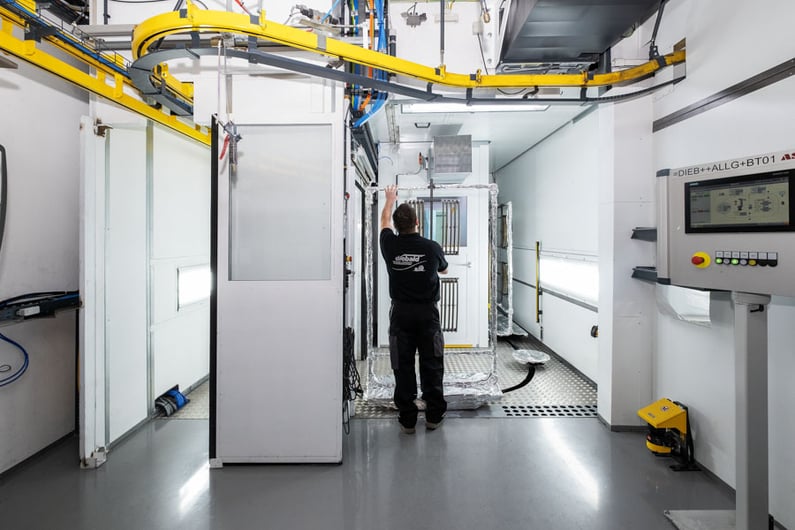
The robot cell, paint mixing room, and conveyor system for feeding parts were all housed within a 32 m² footprint.
Initial Situation: Manual Processes at Their Limit
Before the project, Diebald worked exclusively with manual paint booths. There was no robotic or automated painting in place. For recurring components produced in large quantities, significant limitations became apparent: fluctuating coat thicknesses, limited throughput, and a high dependence on experienced specialists. At the same time, customer demands for quality, reproducibility, and process stability were increasing.
Although a completely new system was considered, it was rejected for the time being. The investment costs and risk were too high, and the disruption to ongoing operations would have been too great. The company was looking for a pragmatic entry into automation—with manageable risk and a clear learning curve.
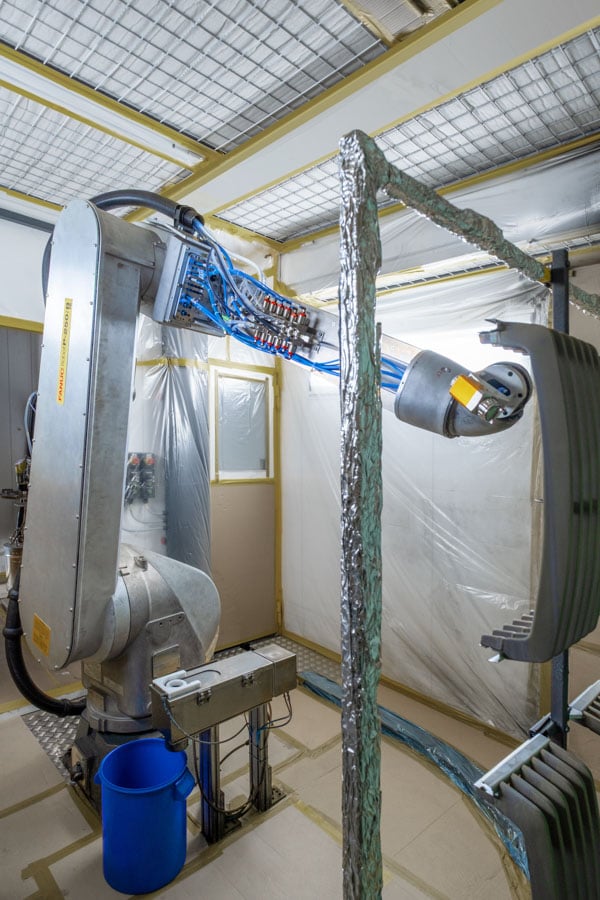
The integration of automation technology doubled capacity and improved quality and reproducibility.
Why a Retrofit Was the Better Decision
The decision was made to retrofit an existing paint booth. An existing manual booth was to be specifically converted into an automated robotic booth. The goal was to gain experience with robotics in a real production environment while simultaneously achieving measurable improvements.
When selecting a partner, Diebald relied on recommendations from the industry. “We asked around the market for partners to integrate robots into the retrofit. ASIS was recommended to us by several sources,” explains Florian Diebald. The deciding factors were their experience with existing systems and their understanding of the specific requirements of a medium-sized coating facility.
Technical Implementation Under Constrained Conditions
The technical implementation posed significant challenges. The existing paint booth was designed entirely as an EX zone. Within a limited space, robots, paint supply, rinsing technology, and the additional Power & Free conveyor system for automated painting had to be integrated.
“The task was extreme. A 32 m² manual paint booth was transformed into an automated paint booth, complete with robots, paint supply, and conveyor systems. On paper, it seemed almost impossible,” says Diebald. Standard solutions were out of the question; the layout had to be custom-designed.
A key element was positioning the paint supply system in close proximity to the robot. This allowed for very short pipeline routes—with significant advantages in terms of paint changeover times and material efficiency.
Efficiency Gains and New Flexibility
The short paint paths pay off in day-to-day production. Paint loss is minimized, in part thanks to the flexible paint supply system—designed specifically for the small space—which accommodates a wide range of container sizes, from approximately 2-liter cups to 30-liter Hobbocks. “The short paint supply lines with minimal paint loss allow us to run even the smallest batch sizes economically through the robot. We can pass this efficiency on to our customers,” explains the managing director.
A technical highlight is the automatic flushing of the paint supply system. The entire system, including the gear pumps, is cleaned within a few seconds. This reduces downtime to a minimum.
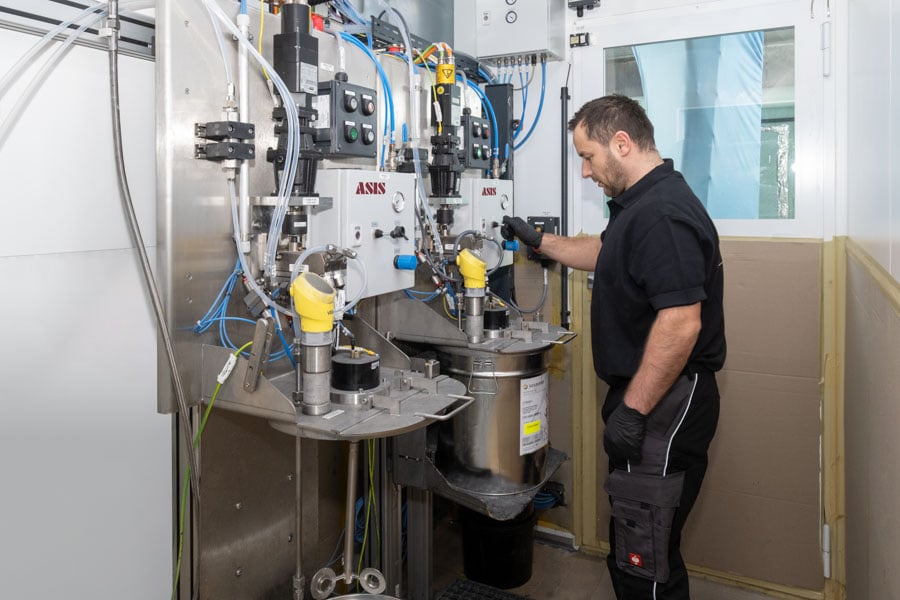
Flexible paint supply for various container sizes and automatic flushing, designed for ATEX-compliant environments
Robotics Without Hesitation
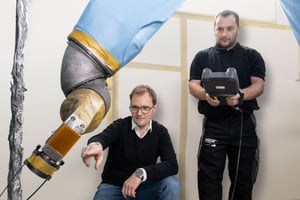
Any reservations about the necessary robot programming were quickly dispelled during the course of the project. A conscious decision was made to use a classic industrial robot—a Painter. After targeted training by ASIS staff, the employees were able to “teach” the robot independently—using the classic and proven method via the teach panel.
This allowed them to fully leverage all the advantages of the specialized Painter robot, particularly the optimized path guidance and the application technology integrated directly into the robot arm. The ability to create and customize programs themselves ensures high flexibility in day-to-day production and quick response times when dealing with new or modified components.
Conclusion: An Evolutionary Step with Impact
The retrofit has proven to be a strategically sound move for Diebald. Coating quality is now more consistent, throughput is higher, and scrap rates are lower. At the same time, the company has built up valuable in-house expertise in automation.
“In conclusion, I can say it was challenging, but it was worth it. We were able to double our capacity, reduce scrap, and bring automation expertise in-house. Even as a small medium-sized company, we took the plunge into robotics and are happy with this evolutionary step,” summarizes Florian Diebald.
-
The retrofit made it possible to enter the field of robotics without having to install a completely new system.
-
Coating quality was significantly improved through more uniform layer thicknesses and color accuracy.
-
Custom-designed paint supply and application systems ensure high cost-effectiveness even for the smallest batch sizes.
-
Employees program the Painter robot independently using a teach panel.
-
The facility gained capacity, reduced scrap, and built up automation expertise.